Accessing business loans with a CCJ is more difficult, but not impossible. Many alternative lenders will consider your application, while many high-street banks auto-decline applications with adverse credit markers. Alternative lenders assess applications differently and consider factors like turnover, profitability, cash flow, assets, industry, and recent trading performance.
Businesses with CCJs may still be able to access a range of funding solutions, including unsecured loans, secured finance, merchant cash advances, asset finance, and invoice finance. The right option will usually depend on the overall financial position of the business and how the lender assesses risk.
This guide explains what a CCJ actually means for lenders, which business loans with CCJ options remain open to you, and the practical steps you can take right now to improve your chances of approval.
What Is a CCJ and Why Do Banks Care?
A County Court Judgment (CCJ) is issued when a court rules that you owe money to a creditor and you haven’t responded to or settled the claim. It stays on your credit file for six years, acting as a red flag to any lender who runs a check. If you pay the judgment in full within one calendar month of the ruling, it can be removed from the register entirely. After that window closes, even a fully satisfied CCJ remains visible, though the fact that it’s been settled does count in your favour.
High-street banks care because their lending models are built around risk minimisation at scale. They process thousands of applications and rely heavily on automated credit scoring. UK SMEs are losing access to up to £5bn in financing, not due to flaws in their business performance, but rather because of the limitations of traditional credit scoring systems. A CCJ, satisfied or not, will typically trigger an automatic decline, regardless of how your business is actually performing today. It’s not personal; it’s just not the way their systems work.
How Alternative Lenders View CCJs Differently
Alternative business finance lenders operate differently when compared to traditional banking and lenders, as they consider context. Examples include:
- Current trading performance: If your business is generating consistent revenue and meeting its existing obligations, that tells a lender far more about repayment likelihood. Many providers will ask for recent bank statements and management accounts to get a real-time picture of cash flow. Many of our lenders specifically ask for open banking data to have a more comprehensive view of your business.
- The nature of the CCJ itself. A single, small CCJ that’s been satisfied carries less weight than multiple active judgments totalling a significant sum.
- Security and collateral. Asset-backed lending, where a loan is secured against property, equipment, invoices, or stock, gives the lender a safety net.
CCJ Business Finance Solutions That Are Available
Here are the main funding routes that remain open to businesses with adverse credit.
Invoice finance is an accessible option for businesses with a CCJ. Because the funding is secured against your outstanding invoices, money your customers already owe you, the lender’s primary concern is the creditworthiness of your clients, not your own credit history. If you’re trading with established, reliable customers, invoice finance can unlock cash tied up in 30, 60, or 90-day payment terms without your CCJ being a deal-breaker.
Asset finance and equipment leasing work on a similar principle. The asset itself acts as security, which means the lender has something tangible to recover if things go wrong. Whether you need vehicles, machinery, or technology, asset finance providers are often willing to work with businesses that carry adverse credit markers.
Short-term business loans and merchant cash advances are available from a growing number of specialist providers. These tend to carry higher interest rates than mainstream products; that’s the trade-off for the increased risk the lender is taking on. A merchant cash advance, in particular, is repaid as a percentage of your card turnover, so the lender’s risk is directly tied to your actual trading activity.
Secured business loans against commercial or residential property can open up larger sums. If you own property with available equity, some lenders will prioritise the security value over your credit file. This route typically suits businesses that need a more substantial amount and have the collateral to support it.
Practical Steps to Strengthen Your Application
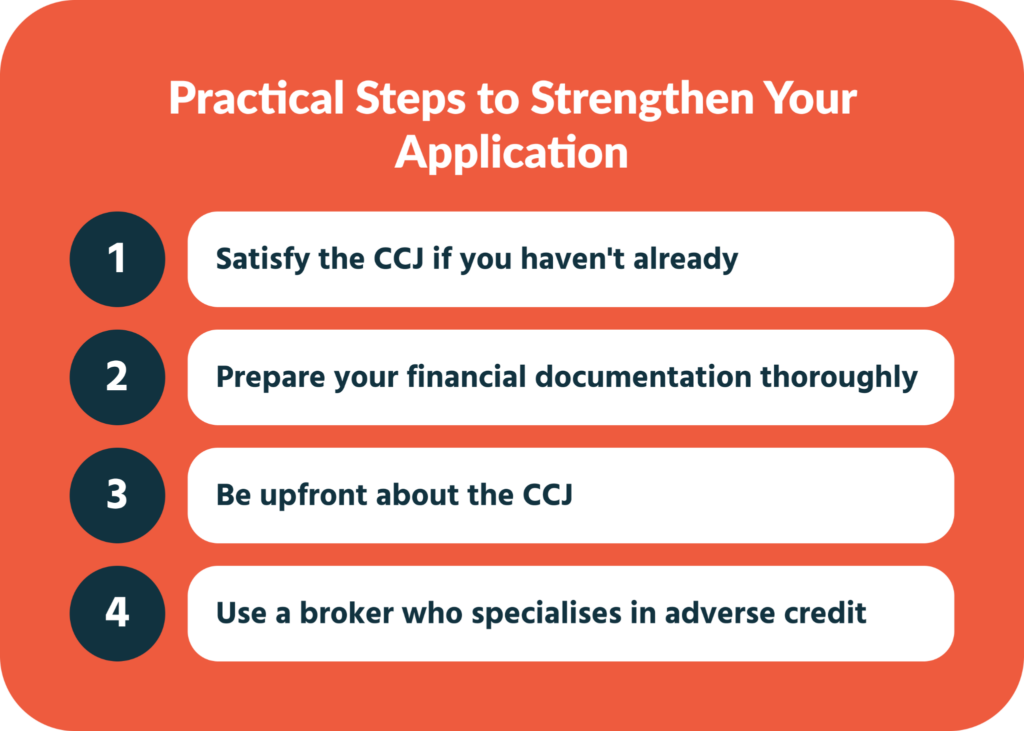
- Satisfy the CCJ if you haven’t already. A satisfied judgment is viewed very differently from an active one, and it will be removed from your file if you pay within the first month and provide proof of payment.
- Prepare your financial documentation thoroughly. Have at least three to six months of bank statements ready, along with up-to-date management accounts, a clear profit-and-loss statement, and, if possible, a cash flow forecast.
- Be upfront about the CCJ. Explain the circumstances proactively, what happened, what you’ve done about it, and why it won’t happen again.
- Use a broker who specialises in adverse credit. Navigating the lending market with a CCJ on your file is significantly easier with someone who already knows which lenders are open to your situation. A specialist broker, like one from Funding Bay, can match you with the right providers, present your case effectively, and save you from racking up multiple declined applications, each of which leaves a footprint on your credit file and can make subsequent applications harder.
What About Bad Credit Business Loans in the UK; Are They Legitimate?
Reputable alternative business finance lenders are typically authorised and regulated by the Financial Conduct Authority. They’ll be transparent about their fees, interest rates, and terms. Funding Bay is an FCA-authorised commercial finance broker that works with over 200 lenders across the traditional and alternative finance markets. We help SMEs with requirements from £20,000 to £25 million across invoice finance, asset finance, business loans, and other products, and they aim to get an offer on the table within 24 hours.
The cost of borrowing will almost certainly be higher than a standard bank loan. What matters is whether the total cost of the facility makes commercial sense for your business.
When the Bank Says No, It’s Not the End of the Road
A CCJ doesn’t define your business. The alternative business finance market exists because the high-street model is stricter and more rigid.
The key is understanding your options, preparing properly, and working with people who know this space. Whether it’s invoice finance, asset-backed lending, or a specialist loan, there are credible CCJ business finance solutions available to businesses that can demonstrate they’re trading well and managing their obligations.

